GIANT WINGS OF THE SEA

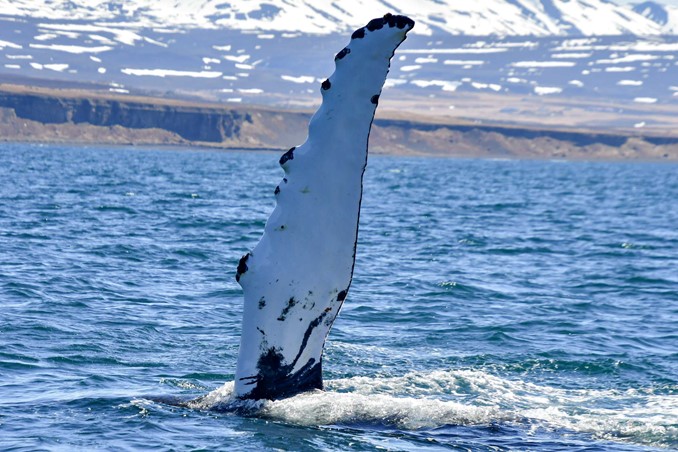
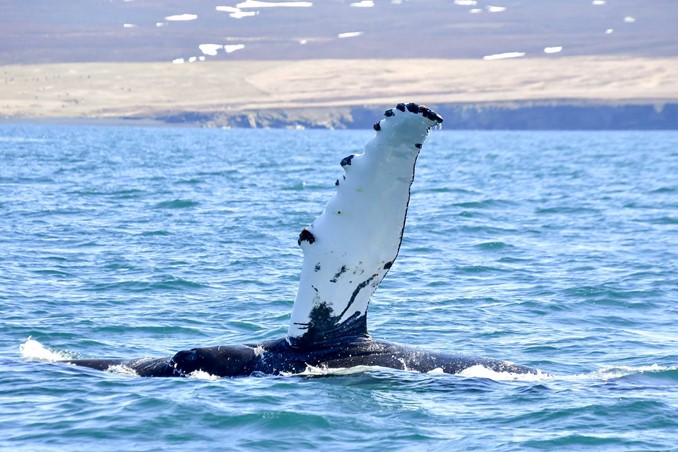
After the first jumps of the season just recently, we had a day all about pectoral slapping the other day—a reminder of just how expressive and active humpback whales can be at times.
Pectoral fins in whales are the evolutionary equivalent of the forelimbs of land mammals. Inside, they contain bones similar to a human arm, including shoulder blades and finger-like phalanges—adapted over millions of years for life in the ocean.
Humpback whales (Megaptera novaeangliae) have the longest pectoral fins of any whale species. These fins can reach up to one-third of their body length, sometimes nearly 5 meters long. Their large size inspired the genus name Megaptera, meaning “large-winged.”
Unlike the tail flukes, which propel the whale forward, the pectoral fins are used for steering, balance, and fine control. They allow humpbacks to make sharp turns, stabilize their bodies, and even swim backward—something rare among marine animals.
A distinctive feature of these fins is their scalloped leading edges, formed by rounded bumps called tubercles. These structures help channel water smoothly over the fin, reducing drag and increasing lift, which improves manoeuvrability during swimming and complex behaviours such as breaching or bubble-net feeding (a feeding technique unique to this species).
Pectoral fins also play a role in temperature regulation. Blood vessels within the fins can constrict to conserve heat in cold waters or expand to release heat in warmer conditions, helping the whale maintain a stable internal temperature.
They also contribute to communication and social behaviour. Humpbacks use their pectoral fins for tactile interaction - stroking one another or slapping the water during social and mating displays. These slaps can produce loud sounds that may signal other whales over long distances.
Overall, these pectoral fins are far more than oversized flippers - in the life of a humpback whale, they are essential for movement, thermoregulation, and social interaction.
Title Photo: Sarah (head guide/captain)
Photo 2+3: Joséphine (head guide/captain)