A CURIOUS VISITOR

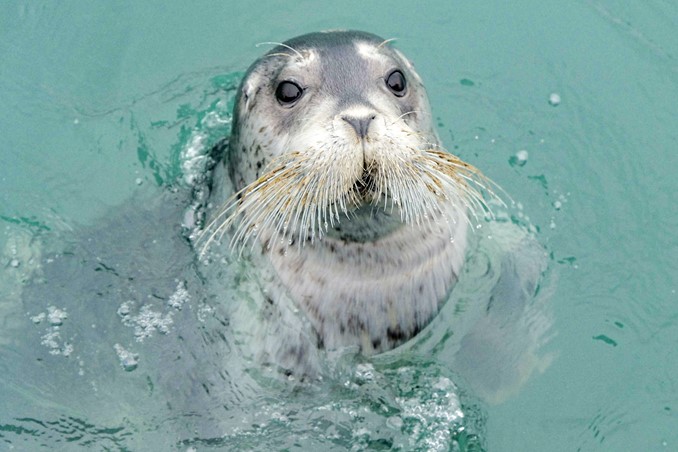
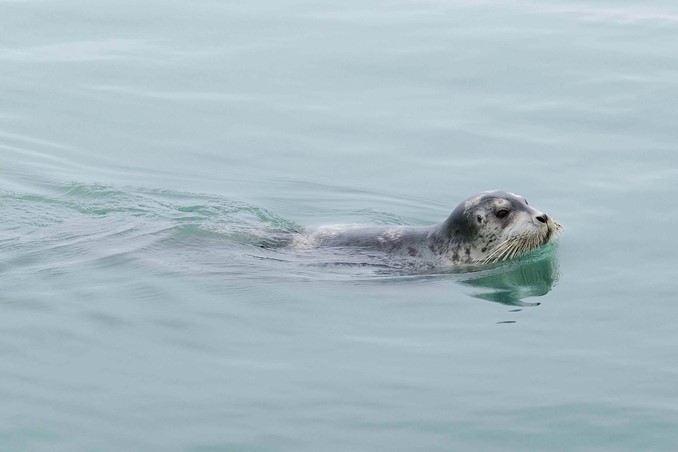
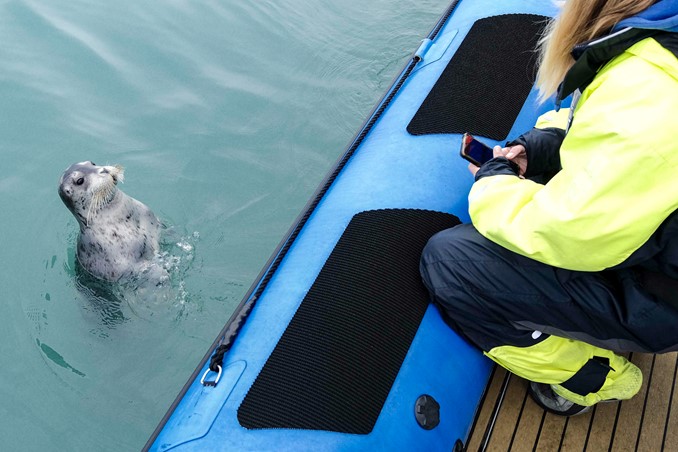
A curious bearded seal has shown up in Skjálfandi Bay recently and while repeatedly approaching and inspecting our boats out of curiosity, it has given us the opportunity to learn some fascinating facts about the Arctic's largest species of true seal (earless seal).
Bearded seals inhabit Arctic and sub-Arctic waters, usually staying close to shallow coastal areas and sea ice. They are easy to recognise by their small heads, square-shaped front flippers and impressive bundles of long, white whiskers — of course the feature that gives them their name.
Their large front flippers and powerful claws help them move through the water and haul themselves onto ice. Bearded seals are also known for their distinctive underwater calls, especially during the breeding season.
Unlike other seal species that chase fast-moving prey in the open ocean, bearded seals are highly specialised benthic feeders, spending much of their time hunting along the ocean floor. Their diet includes clams, shrimp, crabs, squid, fish and a surprising variety of other bottom-dwelling animals, including anemones, sea cucumbers and polychaete worms. During summer, Arctic cod can make up a large part of their diet.
Bearded seals sweep their extremely sensitive whiskers through soft seabed sediments to locate prey hidden beneath the mud. Once they find something, they use suction feeding and powerful jets of water to blast away sediment and pull soft-bodied prey directly into their mouths rather than biting and chewing.
This feeding method has some unusual consequences. Constantly sucking up food along with abrasive sand wears down their teeth, and seals older than around nine years can appear almost completely toothless. Iron-rich compounds from the seabed can also cling to their whiskers and faces while they dig for food. When exposed to oxygen at the surface, the iron oxidises, sometimes giving adults a striking rust- or reddish-coloured face.
Bearded seals are also extraordinary divers, although adults generally stay within about 300 metres. Young pups are capable of diving to around 60 metres when they are only a week old. Juveniles under one year can actually out-dive adults, reaching depths of up to 450 metres.
Their life begins on the sea ice. In spring, females give birth to a single pup directly on drifting pack ice. The pups enter the water within hours of being born and rapidly become capable divers. Mothers nurse their pups on the ice for roughly 24 days, during which the pups grow at an astonishing average rate of around 3.3 kg per day. They can consume approximately 8 litres of rich milk each day. By weaning, a pup may weigh around 100 kg, with body fat making up roughly 25–40% of their weight - a necessity when needing to survive the cold Arctic environment.
So, while this little pup may simply be curious about our boats these days, it is already equipped with some truly extraordinary abilities.
Photos by Miro (guide)