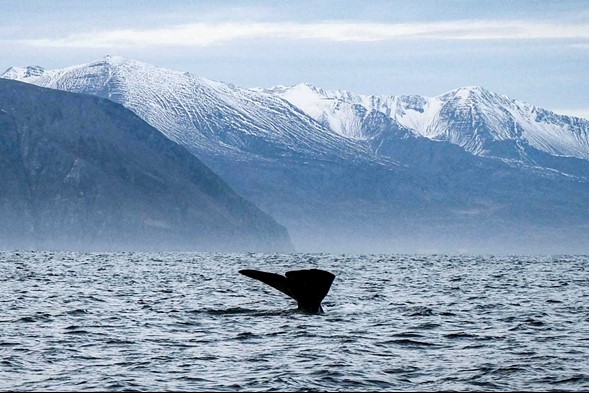
OF RARE VISITORS AND DEEP-SEA DIVERS

Good morning, my dear followers! I’m impressed — you’re patient. And persistent, I suppose. After all, you know I might be gone diving for almost the entire duration of your tour.
Allow me to introduce myself while I catch my breath. I am a SPERM WHALE, just like the two fellows you tried following just before me. Growing up to around 18 metres long, we are by far the largest of the toothed whales — and the largest toothed predators on Earth.
I can see you’re thoroughly inspecting my body. Wondering about all these scars? Every single one tells a tale of a battle with a giant squid — my absolute favourite dish! Though I must admit, the fish in Icelandic waters isn’t bad either.
Or perhaps you’re wondering about the wrinkles behind my head? Actually, have you noticed just how enormous my head is? It accounts for about one-third of my total body length.
And here’s something that really makes me unique: I have a single blowhole, asymmetrically positioned on the left side of the top of my head. Also, surely you’ve noticed my brownish-grey colouration, which makes me stand out among the other whales you might encounter here in the bay.
But before I leave you waiting again, how about a few fun facts to keep you entertained in the meantime?
- We are the largest toothed whales as said, yet our large, conical teeth are found only along our narrow lower jaws. The teeth in our upper jaws usually remain hidden or never erupt at all.
- We also have the largest brain of any animal on Earth, weighing around five times as much as yours!
- And when we need a little rest, we like to sleep vertically, almost motionless, with our heads pointing towards the surface. Quite a peculiar sight, isn’t it?
- When we’re awake and foraging, we oftentimes dive to depths of around 2,000 metres or more, holding our breath for over an hour. Imagine trying that on your next swimming trip!
- And then there’s my voice. Oh, I’m loud! My clicks can reach around 230 decibels when measured underwater, making them among the loudest sounds produced by any animal. To put that into perspective, a jet engine produces around 150 decibels when measured in air.
- My language consists of rhythmic sequences of clicks called codas. Different family groups have distinctive calling patterns, a bit like cultural accents. We use clicks for communication as well as for echolocation — helping us navigate the darkness and locate prey in the deep ocean. These clicks are produced by a specialised sound-producing system in my head, involving structures associated with a fatty, wax-filled organ called the spermaceti organ. Oh, come on — what did you think my name came from?
Anyway, enough about me for now. I’ve got some serious diving to do!
See you in an hour or so!
PHOTOS BY MIRO (GUIDE)